
TEETH GRINDING & DENTAL IMPLANTS
Clench or grind? Here’s how to protect your implants — and the teeth you still have.
Yes, you can have dental implants if you clench or grind your teeth — you just have to plan for it. Natural teeth sit in a thin cushion of ligament that absorbs force and tells your brain when you’re biting too hard. Implants fuse directly to bone, with no cushion and much less of that early-warning feedback. So the force of a stress clench at your desk, or a night of grinding, goes straight into the crown, the small screw that holds it, and the bone underneath. Grinders aren’t turned away here — their plan is simply built differently.
How common is clenching and grinding?
Very — and most people who do it don’t know. A 2024 analysis pooling studies from around the world put it at about 22% of people: roughly 23% clench while awake and 21% clench or grind in their sleep, with North America showing the highest rate of sleep grinding, at about 31%. Daytime clenching tends to happen during concentration, driving, screen time and stress. Nighttime grinding is usually discovered by a bed partner — or by a dentist looking at worn teeth.
Signs you might be a clencher
- A sore or tired jaw when you wake up, or headaches at your temples
- Teeth that look flattened, chipped or worn — or that have started to crack
- Teeth that have turned sensitive for no obvious reason
- Scalloped edges along your tongue, or a white ridge along the inside of your cheek
- A partner who hears you grinding at night
- If you already have implants: chipped porcelain, or an implant crown that starts to feel loose
What clenching does to implants
The research is most consistent about mechanical damage: in people who clench or grind, implant crowns and bridges chip and fracture more often, and the small screws that hold them in place loosen or break more often. Some studies also find higher implant failure rates in heavy grinders. None of that makes implants a bad idea for grinders — it makes planning essential. The same forces also explain why grinding is a common reason natural teeth crack beyond repair, which is how many people end up needing an implant in the first place.
How we plan implants for people who clench
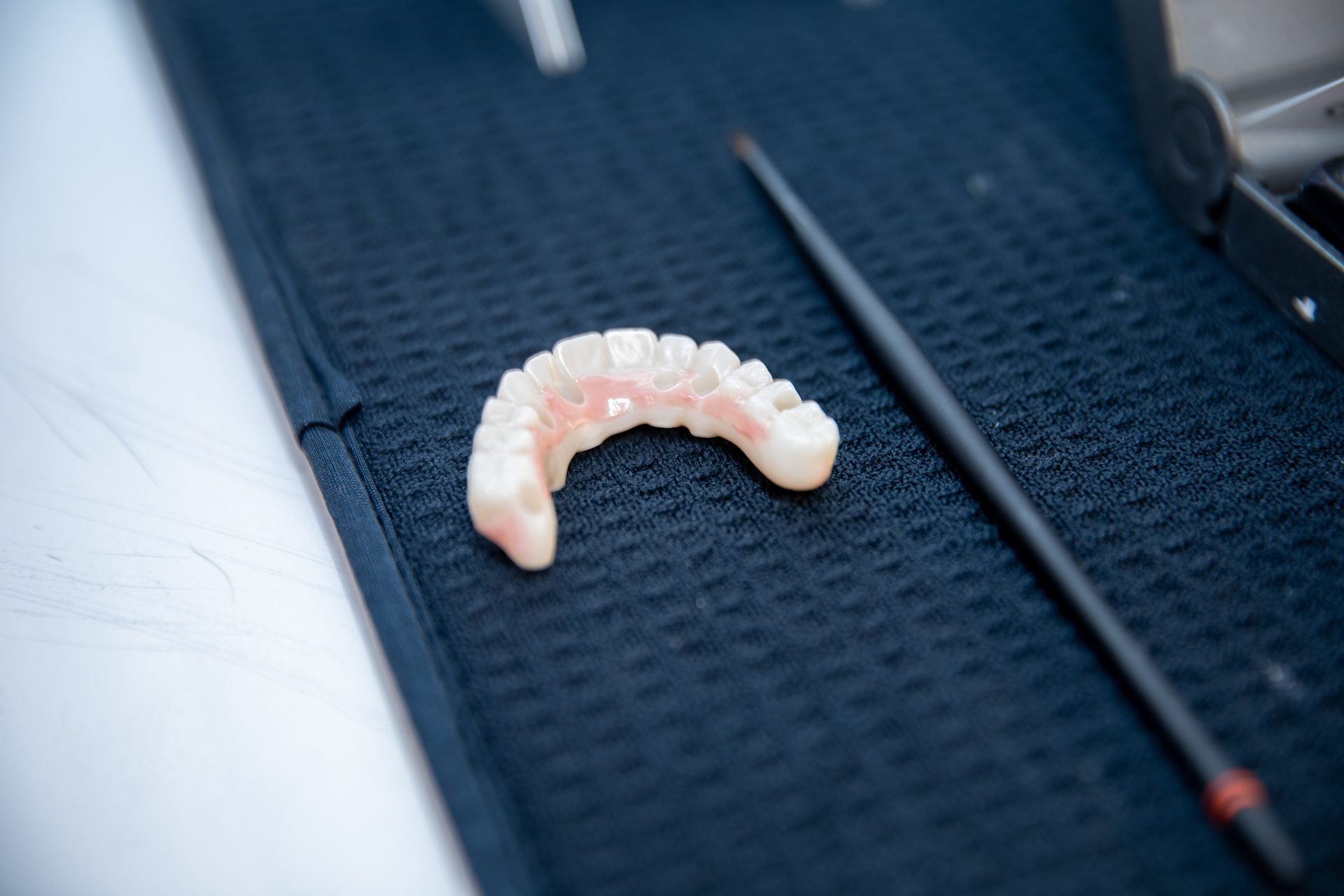
Tell us at your consult if you clench, grind, or wake up with a sore jaw — or if a dentist has ever told you your teeth show wear. It changes the plan, not the answer. Clenching can affect the material we choose for your new teeth, how we design your bite so forces spread evenly, and whether same-day teeth make sense or a short, protected healing period should come first. Once your final teeth are in, a custom night guard is the cheapest insurance in implant dentistry — especially over a full-arch bridge like All-on-4, which carries your entire bite.
Dr. Oestervemb is double board-certified, in implant dentistry (ABOI/ID) and in general dentistry (ABGD), so the bite your implants have to live in gets as much attention as the implants themselves.
Easy ways to relax your jaw at home
A night guard protects your teeth from grinding; it doesn’t stop the habit. These help with the habit itself:
- Learn your jaw’s resting position. Lips together, teeth apart, tongue resting lightly on the roof of your mouth just behind your front teeth. Your teeth should only touch when you chew or swallow.
- Set check-in reminders. A phone alarm a few times a day, or a small sticker on your monitor or steering wheel. Each time you see it, ask: are my teeth touching? If they are, let your jaw drop and reset.
- Use warmth and gentle massage. A warm compress on the sides of your face for 10 to 15 minutes, then slow circles with your fingertips on the muscles in front of your ears and at your temples.
- Cut the extra chewing. Gum, ice, pen caps, fingernails and very tough foods all keep your jaw muscles working overtime.
- Watch the evening triggers. Caffeine late in the day, alcohol and nicotine are all linked to more nighttime grinding, and stress is a major driver, so a calmer wind-down before bed helps.
When to get it checked
See a dentist if jaw pain lasts more than a couple of weeks, if your jaw clicks painfully, locks, or won’t open fully, or if you’re noticing chipped or cracked teeth. Most jaw-joint (TMJ) problems improve with simple, reversible care, and our sister practice in the same building, Smiles of Virginia Family Dental Center, treats TMJ disorders. And if the grinding comes with loud snoring, gasping at night or daytime exhaustion, mention that too: nighttime grinding is linked to sleep apnea, which is worth ruling out.
Custom night guard or drugstore guard?
A drugstore boil-and-bite guard is a reasonable stopgap, but it’s bulky, fits loosely, and wears through quickly in a real grinder. A custom guard is made from a scan or impression of your mouth, covers all of your teeth so your bite stays stable, and is built to last for years — which matters even more when it’s protecting implant crowns or a full-arch bridge.
Can I get dental implants if I grind my teeth?
Yes. Grinding changes how we plan — the material for your teeth, your bite design, your healing time and a night guard afterward — but on its own it doesn’t rule implants out.
Do I need a night guard with dental implants?
If you clench or grind, or a dentist has seen signs of it, yes. Implants have no natural shock absorber, and a guard costs far less than repairing a chipped crown or replacing a broken screw.
Do I need a night guard with All-on-4?
If you clench or grind, plan on one. A full-arch bridge carries your entire bite, so it’s the restoration with the most to lose from a night of grinding.
Can grinding make an implant fail?
It can contribute. Studies most consistently link grinding to mechanical problems — chipped teeth and loose or broken screws — and some find higher failure rates in heavy grinders. Planning for it, and wearing a guard, reduce that risk.
Will a night guard stop me from clenching?
No — it protects your teeth and implants from the damage. Reducing the habit itself comes down to the at-home steps above: your resting position, regular check-ins, and managing stress and sleep.