
GUIDED SURGERY
Your implant surgery happens twice. The first time, you’re not in the room.
Before you sit down, your entire procedure has already been performed once — on a computer, in three dimensions, using a model built from your own anatomy. Every implant position is decided, checked against your nerves and sinuses, and rehearsed. Only then is a custom guide printed to carry that plan into your mouth.
The alternative is called freehand: the surgeon judges angle and depth in the moment, working from a two-dimensional X-ray and experience. It’s legal, it’s common, and in skilled hands it often works. But it asks you to accept a margin of error that no longer has to exist.
Every implant placed at this center is planned in 3D and placed fully guided. Not the difficult ones. Not as an upgrade. All of them, as the standard workflow, included in the published price.
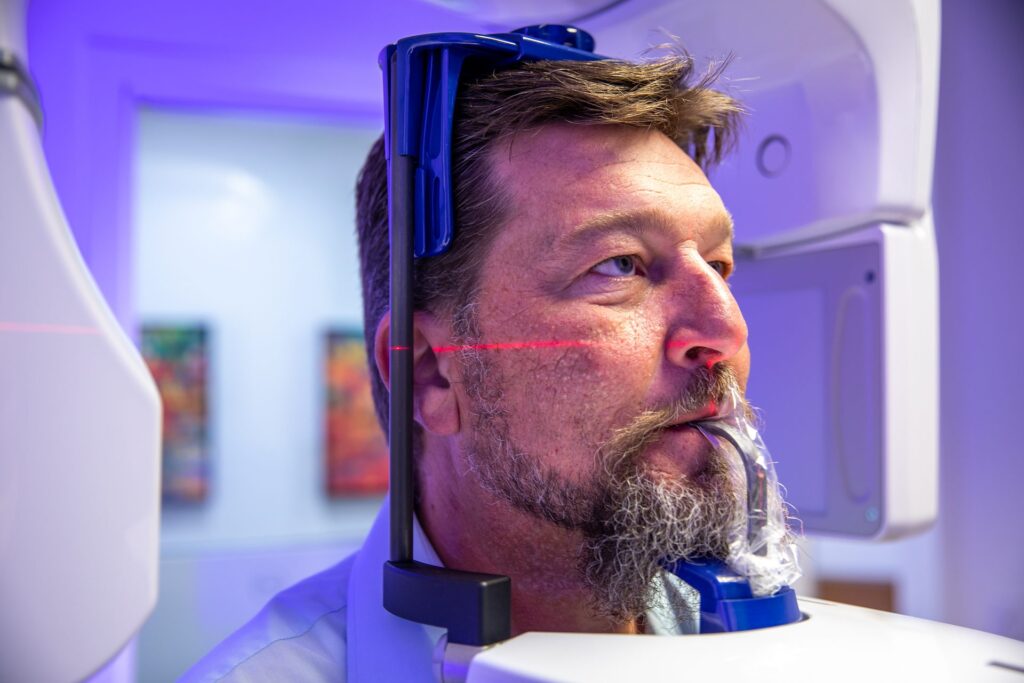
How the digital surgery is built
It takes two scans, because neither one alone is enough.
The cone-beam CT captures what’s underneath — bone height, width and density, the path of your nerves, the floor of your sinuses. What it can’t render precisely is soft tissue, and gum contour is exactly what determines whether a finished tooth looks like it grew there.
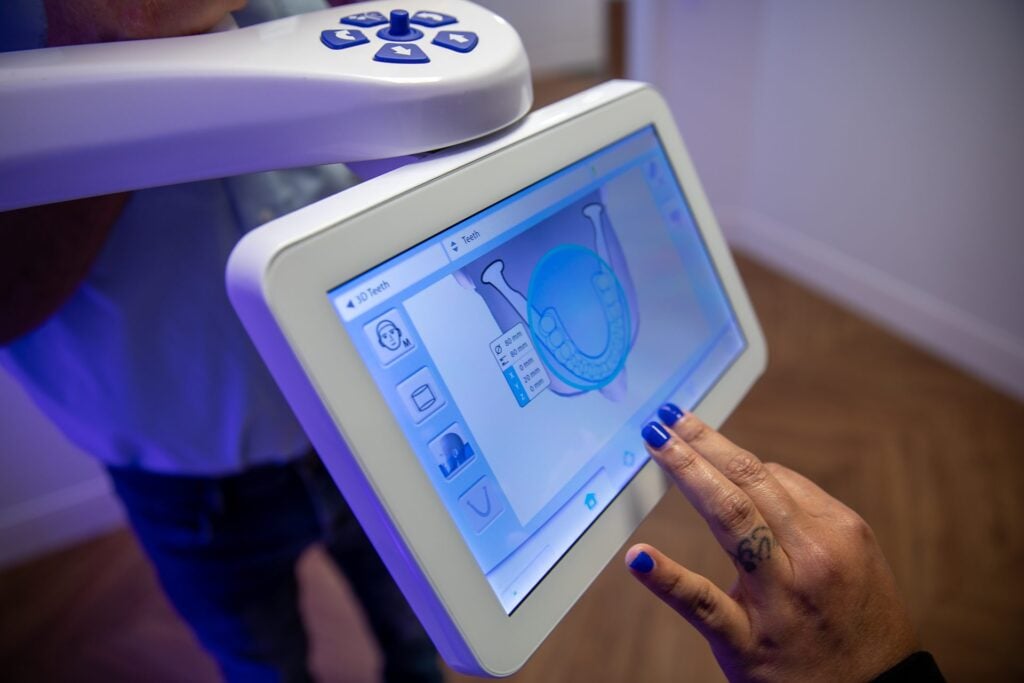
The intraoral scan fills that gap. A small camera wand records your teeth and gums in colour and in three dimensions, using no radiation at all — it’s photography, not X-ray.
Merging the two produces a single model containing both your skeleton and your surface. From there the sequence runs backwards from the result, which is the part that matters most: your final teeth are positioned first, exactly where they need to be for your face and your bite — and the implants are then planned to support them. Placing implants where bone happens to be convenient and building teeth to match afterwards is how you end up with a restoration that works mechanically but never looks right.
The finished plan is 3D-printed as a surgical guide: a physical template that seats on your jaw and constrains each drill to the planned angle, depth and rotation.
What it changes for you
- Smaller incisions, or none. When the plan is certain, the surgeon doesn’t need to open tissue to see what’s underneath. Many guided placements are done through a small opening in the gum rather than by lifting a flap.
- Less swelling and a milder recovery. Less tissue disturbed, less to heal, less bone loss around the site.
- Anatomy avoided by design. Nerves and sinus floors are mapped and given clearance on screen, where a mistake costs nothing to correct.
- Shorter time in the chair. The deliberation already happened. What remains is execution.
- Implants where bone is strongest. Which is the foundation of same-day teeth, and of results measured in decades.
- Fewer surprises. The unexpected findings that turn a routine case complicated tend to appear during planning instead of mid-procedure.
The same planning is used for sinus lifts and bone grafting, not just implant placement.
So why doesn’t every office work this way?
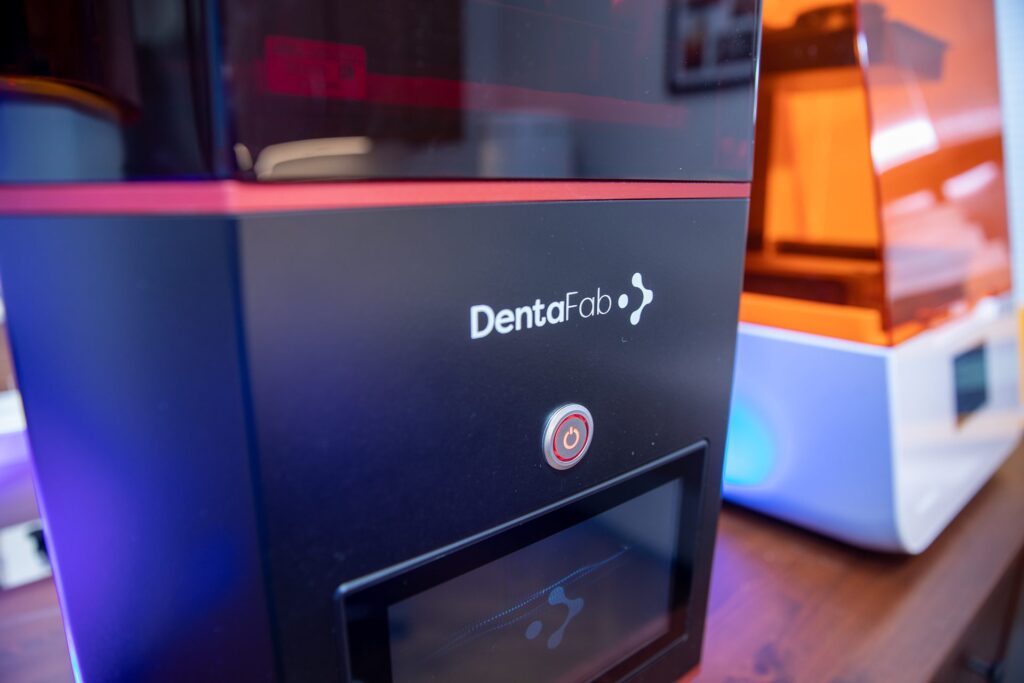
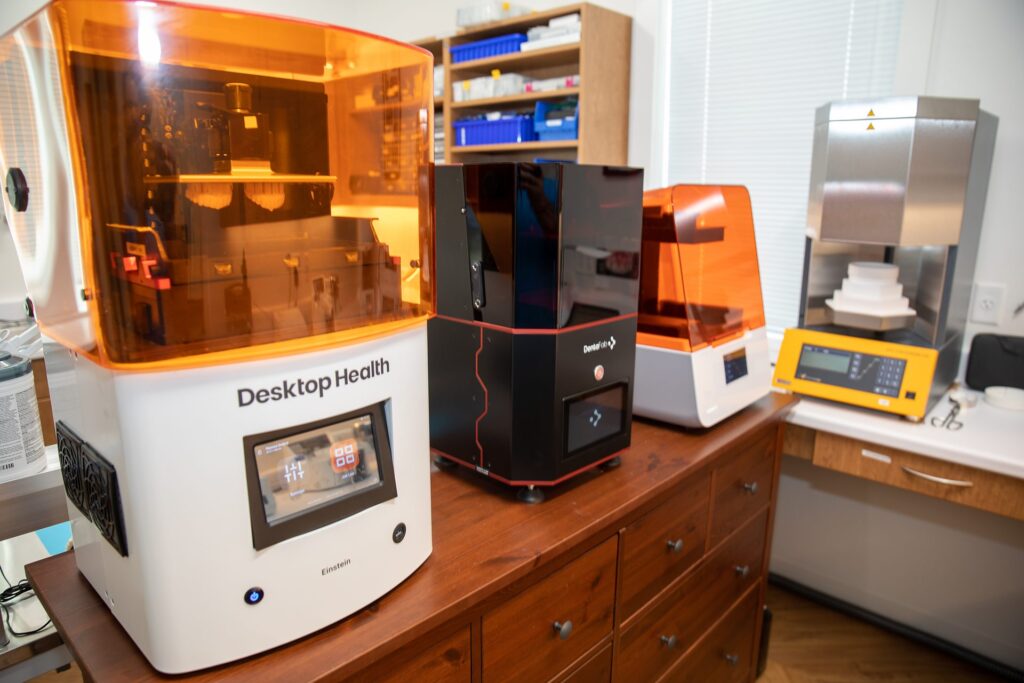
Because the entry cost is genuinely high, and it isn’t one purchase. It’s a cone-beam CT scanner, an intraoral scanner, a 3D printer, guided surgical kits for each implant system, the planning software, and — the part that can’t be bought — the training and case volume to use all of it well.
For a practice that places a few implants a month, that investment is difficult to justify. For a center built around implant dentistry, it’s the baseline. That’s the honest answer, and it’s also why the question “will my implant be placed with a guide, or freehand?” separates providers so efficiently. It’s one of seven worth asking every office you visit.
Who’s holding the plan
A guide doesn’t place an implant; it constrains a drill. The judgment about where that implant should go in the first place — and whether you should have one at all — belongs to the person who made the plan.
Dr. Oestervemb is a Diplomate of the American Board of Oral Implantology / Implant Dentistry, the only one in Winchester, and teaches the integration of digital technology into implant surgery to practicing dentists as faculty on the AAID Mid-Atlantic Implant MaxiCourse. The workflow described on this page is, quite literally, what he trains other dentists to do.
Is guided surgery safer than freehand?
It reduces the margin for error, which is a different claim from eliminating risk. Planning in 3D means the anatomy is known rather than inferred, and the decisions are made unhurried on a screen instead of under time pressure in the chair. Any surgical procedure carries risk; this narrows one specific category of it.
Does the guide cost extra?
No. Planning and the printed guide are part of how implants are done here and are built into our published prices — not presented as an optional upgrade after you’ve committed.
Does it add appointments?
No — both scans are taken at your consult, and the planning happens between visits rather than during them. Because the lab and printer are in this building, the guide is produced here rather than shipped out and waited on.
Is the 3D scan of my mouth uncomfortable?
It replaces the impression tray full of material that used to make people gag. It’s a camera wand, it takes a few minutes, and you can swallow and breathe normally throughout.