

How Long Do Dental Implants Last? The Bone Decides
By Dr. Niels Oestervemb, DDS — Double Board-Certified: Implant Dentistry (ABOI/ID) & General Dentistry (ABGD) · Zero Bone Loss Concepts Ambassador
Short answer: a dental implant can last 25 years or more, and many last the rest of a patient’s life. The titanium post almost never breaks. The crown or bridge attached to it is a wear part — expect to replace it somewhere between year 10 and year 20. And the thing that decides which of those futures you get is not the brand of implant. It is the bone around it.
What “lasts” actually means — part by part
- The implant post (titanium, in the bone): decades, often a lifetime. Large published reviews report survival above 95% at ten years, with implants placed in the 1980s and 90s still functioning today. The post itself is rarely the thing that fails.
- A single crown on an implant: typically 10–20 years before chipping, wear, or a shade change prompt a replacement. Zirconia crowns sit at the long end of that range.
- A fixed full-arch bridge (All-on-4 / All-on-6): a zirconia final bridge is designed for 15+ years; older acrylic-on-titanium hybrids often need relining or remaking in 5–10.
- A snap-in implant denture: the little retention inserts wear out and get swapped roughly once a year; the denture itself lasts about 5–10 years.
Notice what is missing from that list: the bone. No manufacturer puts a lifespan on it, because it is not a part. But it is the foundation every other part sits on — and it is the one thing that quietly decides whether an implant is still solid at year twenty.
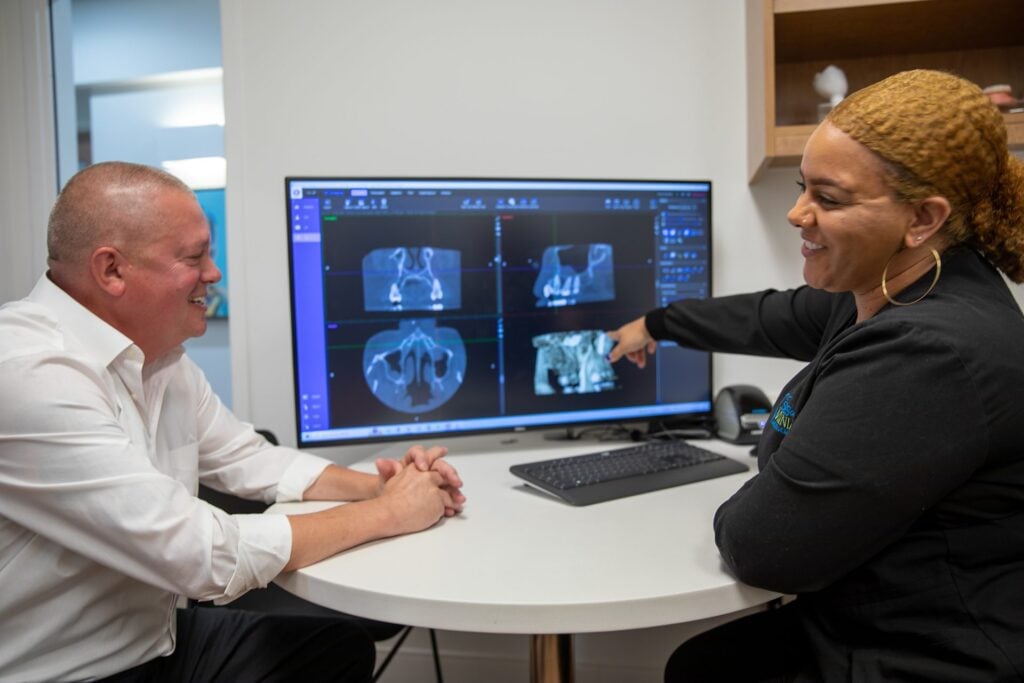
Why the bone decides
Implants rarely fail by breaking. They fail — or start looking and feeling wrong — because the bone at the rim of the implant recedes. When it does, the gum follows it: a grey line appears at the edge of the crown, a dark triangle opens beside the tooth, food packs where it never did, and bacteria reach parts of the implant surface they were never meant to touch. That is peri-implantitis, the infection that takes implants out years after the surgery was declared a success.
Here is the part most patients are never told. The success criteria the profession has used since 1986 accept up to about 1.5 mm of bone loss around an implant in the first year of function, then up to 0.2 mm every year after. An implant can meet that definition of “success” and still lose a third of its supporting bone over twenty years. We think that standard is out of date — and the research agrees.
Five things your dentist controls
Prof. Tomas Linkevičius of Vilnius University spent two decades measuring which choices lead to bone that stays and bone that goes. Dr. Oestervemb trained with him at his first course in the United States and follows the protocol, known as Zero Bone Loss Concepts, on every implant. The five findings that matter most:
- Gum thickness before surgery. Implants placed into thin gum tissue (under 3 mm) lost up to about 1.45 mm of bone in the first year; in thick tissue (3 mm or more) the loss was around 0.2 mm. Thin tissue can be measured and thickened before the implant goes in. Most offices never measure it.
- Placement depth. Different implant designs belong at different depths. Placing every implant “at bone level” by habit is one of the quiet causes of early loss.
- The connection. A tight conical implant-to-abutment joint with a polished collar gives bacteria far less to colonize at the seam where bone meets implant.
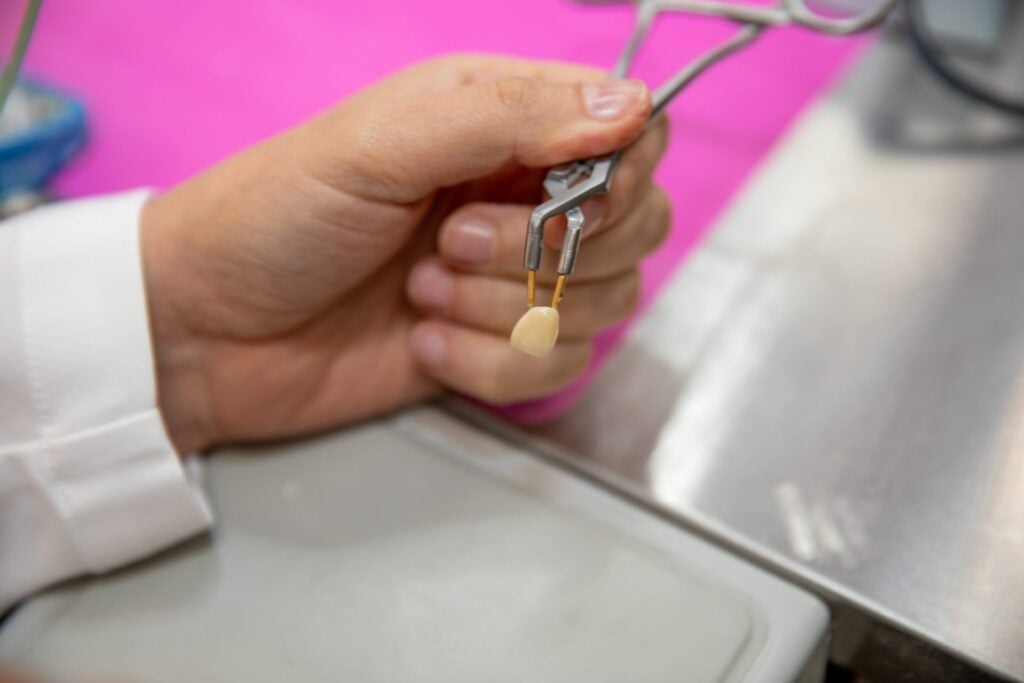
- Cement. Leftover cement under the gum is a well-documented trigger of peri-implantitis. Screw-retained zirconia teeth, polished where they meet the gum, remove that risk entirely.
- The shape of the tooth at the gumline. The emergence profile affects whether bone stays stable — which is why it should be designed by the lab that works with the surgeon, not shipped in from three states away.
Every one of those is decided before you ever bite on the tooth — along with position, angulation, and bite engineering, which is why 3D planning and fully guided placement by a board-certified implant dentist is the down payment on the next thirty years. The six-step standard we follow on every implant is published here, in plain English, so you can hold us to it — and so you can ask any other office the same questions.
Five things you control
- Smoking. The single biggest patient-side risk factor; in most studies smokers lose implants at roughly double the rate of non-smokers. Quitting before surgery and through healing changes the odds more than any implant brand ever will.
- Blood sugar. Well-controlled diabetes is not a barrier to implants. Uncontrolled diabetes slows healing and feeds infection. Know your numbers before surgery.
- Grinding and clenching. Implants have no ligament to cushion them, so overload shows up as loosened screws, chipped porcelain, and — over years — bone loss. A night guard is the cheapest insurance an implant patient can buy. More on grinding and implants here.
- Home care. Implants don’t get cavities, but they are not maintenance-free: brush like natural teeth, clean beneath a bridge with the tools we teach you, and treat bleeding around an implant as a message, not a nuisance.
- Maintenance visits. Professional cleaning every six months and a bone-level X-ray at least yearly. Bone loss is measurable years before anything hurts, and a small problem caught on an X-ray is cheap; the same problem caught by a loose implant is not.
How implants compare with the alternatives
| Option | Typical service life | Then what? |
|---|---|---|
| Dental implant (the root) | Decades — often lifetime | Maintain it, and keep the bone around it |
| Implant crown | 10–20 years | New crown on the same implant |
| Fixed full-arch bridge (zirconia) | 15+ years | New bridge on the same implants |
| Traditional tooth-supported bridge | 7–15 years | Full replacement — sometimes taking the anchor teeth with it |
| Conventional dentures | 5–10 years per set | Remake, reline, repeat — while the bone keeps shrinking |
Run the 20-year math and the “expensive” option usually isn’t. An implant done right, once, tends to beat every alternative you’d have bought twice — the implant-vs-bridge comparison with real numbers is here, and an implant-supported denture stops the shrinking-bone cycle that conventional dentures run on.
Signs an implant is losing bone
Bleeding or a bad taste around the implant. Gum pulling away so that a grey collar or threads start to show. Food packing where it never did. Swelling, tenderness, or a crown that feels different when you bite. And, most often, nothing at all — which is why the X-ray matters.
If your implants were placed anywhere — last year or fifteen years ago — bring your most recent X-rays, or let us take a fresh 3D scan at no charge. Dr. Oestervemb will measure the bone around each implant and put what he sees in writing. If it is stable, you’ll hear that. If it is starting to move, you’ll hear that too, while it is still a small problem. Free second opinions and bone checks are here.
Frequently asked questions
Do dental implants last forever?
The titanium post can last a lifetime once it has fused to the bone and stays free of infection. The crown or bridge on top is a wear part, replaced roughly every 10–20 years. Whether “a lifetime” happens depends on the bone staying where it started.
What is the 10-year success rate?
Large published reviews report implant survival above 95% at ten years. Survival is not the same as healthy, though: an implant can survive while steadily losing bone, which is why we track the bone level, not just whether the implant is still there.
Can a failed implant be replaced?
Usually yes — after the site heals, and often after grafting to rebuild what was lost. Catching bone loss early costs a fraction of replacing an implant.
Does the implant brand matter?
Less than how it is placed and restored. Design features matter — a conical connection, a polished collar, a surface made for bone — but brand marketing does not. Ask how the implant will be placed and how the teeth will be attached, not just what the box says.
How often should implants be checked?
Professional cleaning every six months and a bone-level X-ray at least once a year — more often if you grind, smoke, or have a history of gum disease.
Built to outlast the question
The implants we place are planned in 3D, placed fully guided, restored by the same doctor, maintained down the hall from where they were made — and measured, so the bone around them stays where it started. See what your case would look like: free consult, free 3D scan, complete written pricing.
Lifespans above are typical ranges from published research for education, not a guarantee; your outcome follows an exam and depends on the factors described here.


