ZERO BONE LOSS CONCEPTS
Most dentists call 1.5 mm of bone loss a “successful” implant. We don’t.
An implant is only as permanent as the bone holding it. For nearly forty years the profession’s definition of success has quietly allowed the bone around an implant to melt away — a little in the first year, a little more every year after. Dr. Oestervemb is a Zero Bone Loss Concepts Ambassador, trained by Prof. Tomas Linkevičius, the researcher who showed that this loss is a preventable complication, not the price of having an implant. This page explains what that means for your teeth in year one and year twenty — and exactly what we commit to on every implant we place.
Why the bone matters more than the implant
Implants rarely fail because the titanium breaks. They fail — or start looking and feeling wrong — because the bone at the rim of the implant (dentists call it the crestal bone) recedes. When it does, the gum follows: a grey line appears at the edge of the crown, a dark triangle opens beside the tooth, food packs where it never did, and bacteria reach parts of the implant surface they were never meant to touch. That is the start of peri-implantitis, the infection that takes implants out years after the surgery was declared a success.
Here is the part most patients are never told. The success criteria the profession has used since 1986 accept up to about 1.5 mm of bone loss in the first year of function, then up to 0.2 mm every year after that. An implant can meet that definition of “success” and still lose a third of its supporting bone over twenty years. We think that standard is out of date — and so does the research.
What the research found — in sixty seconds
Prof. Linkevičius and the Vilnius Research Group spent two decades measuring which choices lead to bone that stays and bone that goes. Five findings drive everything we do:
- Gum thickness decides the first year. Implants placed into thin gum tissue (under 3 mm) lost up to about 1.45 mm of bone in the first year; in thick tissue (3 mm or more) the loss was around 0.2 mm. Thin tissue is the most common, most ignored reason implants lose bone early — and it can be measured and thickened before surgery.
- Depth is not one-size-fits-all. Different implant designs belong at different depths. Placing every implant “at bone level” by habit is one of the quiet causes of early loss.
- The joint matters. A tight, conical implant-to-abutment connection and a polished collar give bacteria far less to colonize at the seam where bone meets implant.
- Cement is the enemy. Leftover cement under the gum is a well-documented trigger of peri-implantitis. Screw-retained zirconia teeth, polished where they meet the gum, remove that risk entirely.
- Shape matters too. The contour of the tooth where it emerges from the gum (the emergence profile) affects whether the bone stays stable — which is why we design it ourselves, in our own lab.
Our Zero Bone Loss Standard — six things we do on every implant
Being an Ambassador is a training designation, not a magic word. What it means in practice is a protocol — and here it is in plain English, so you can hold us to it:
- We measure your gum thickness before surgery. If it is under 3 mm, we thicken it first, so the bone has what it needs to stay.
- We place the implant at the depth its design calls for — planned in 3D and placed fully guided, not eyeballed.
- We use implants with a tight conical connection and a polished collar, chosen for bone stability rather than for the lowest price.
- Your teeth are screw-retained zirconia, polished below the gumline. No cement under your gums, ever.
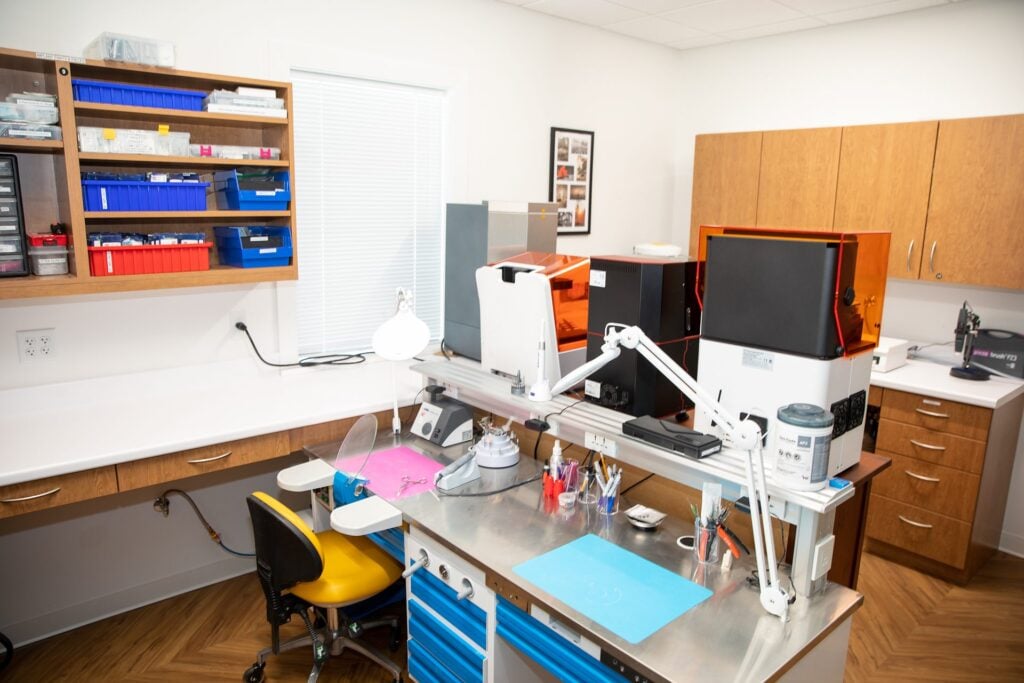
- The emergence profile is designed and built in our on-site lab — forty feet from your chair, by technicians who answer to the same doctor who placed the implant.
- We measure the bone level on an X-ray when your teeth go in, and we check it at your follow-ups. You’ll see the number. If it moves, we’ll know early.
One thing we will not do is promise you biology. Smoking, uncontrolled diabetes, heavy grinding and untreated gum disease all push against any protocol — which is why we talk about every one of them at your consult. What we promise is the protocol, the measurement, and a straight answer about what we see.
What it means for you
- An implant that stays put. Stable bone is what keeps an implant solid at year ten and year twenty, not just at the first check-up.
- Gums that don’t shrink back. When the bone holds, the gum holds — no grey line, no black triangles, no “implant look.”
- Far less to repair later. Peri-implantitis is expensive to treat and heartbreaking to lose an implant to. Preventing it is the cheapest dentistry you will ever buy.
Already have implants? Get a free bone-level check.
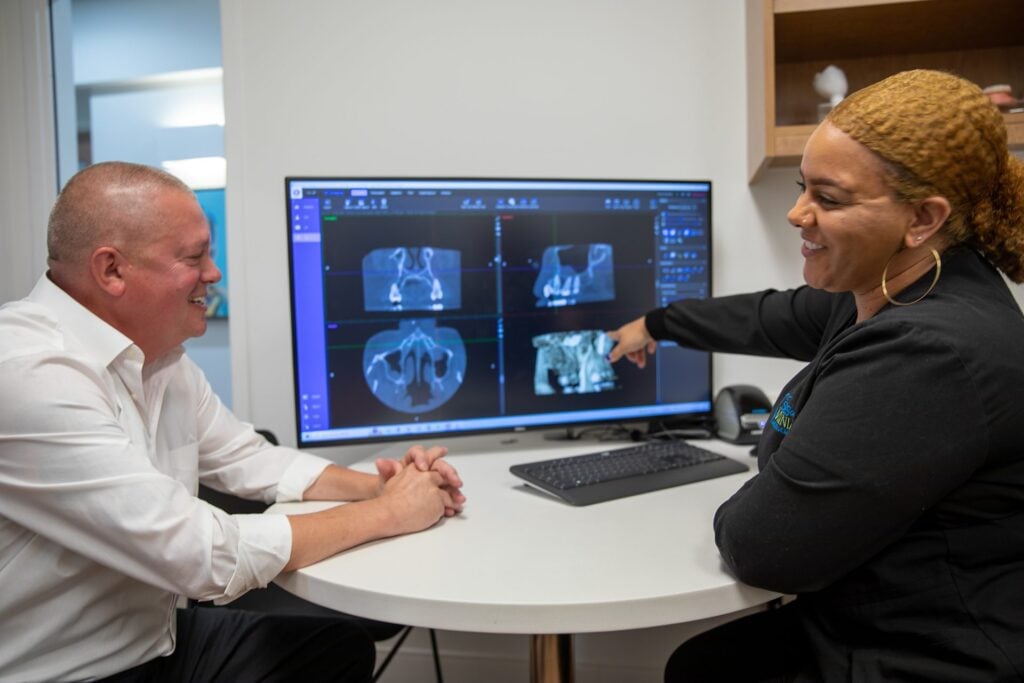
If your implants were placed anywhere else — last year or fifteen years ago — bring your most recent X-rays, or let us take a fresh 3D scan here at no charge. Dr. Oestervemb will measure the bone around each implant, tell you plainly what he sees, and put it in writing. If everything is stable, you’ll hear that. If something is starting to move, you’ll hear that too — while it is still a small problem. Second opinions on failing implants are a normal part of our week.
Why Dr. Oestervemb trained with Prof. Linkevičius
Prof. Tomas Linkevičius, DDS, PhD, is a professor at Vilnius University in Lithuania, founder of the Vilnius Research Group, and author of Zero Bone Loss Concepts (Quintessence, 2019), the textbook that reset how implant dentists think about bone. His doctoral research was on exactly this subject — how gum thickness determines bone stability — and he reviews for the leading implant and periodontology journals. More than 500 dentists worldwide have studied his protocol; a much smaller group have trained with him directly and been named Zero Bone Loss Concepts Ambassadors.
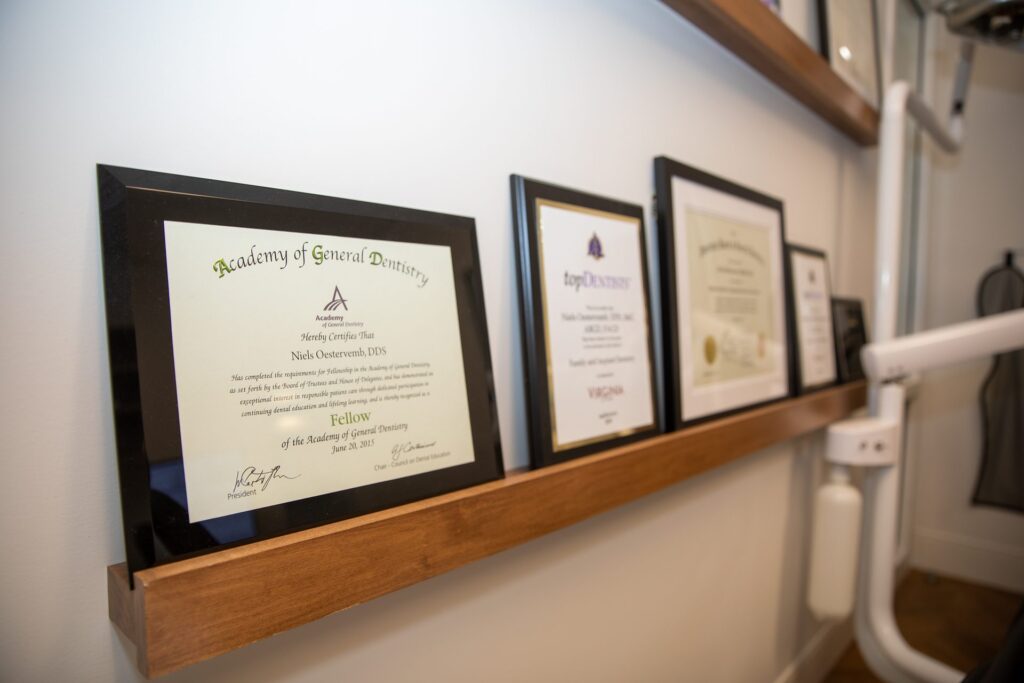
Dr. Oestervemb trained with Prof. Linkevičius at the professor’s very first course in the United States — Las Vegas, 2019 — and in 2026 was named a Zero Bone Loss Concepts Ambassador. He already held the credentials patients look for — Diplomate of the American Board of Oral Implantology, the only one in Winchester; board certification in general dentistry; faculty of the AAID Implant MaxiCourse, where he teaches other dentists implant surgery. He went anyway, for a simple reason: the old success standard never sat right with him, and here was the research showing it didn’t have to.
Frequently asked questions
What is Zero Bone Loss Concepts?
Zero Bone Loss Concepts (ZBLC) is an evidence-based surgical and prosthetic protocol developed by Prof. Tomas Linkevičius to develop and keep stable bone around dental implants. It covers how the gum is prepared, how deep and which implant is placed, and how the final teeth are designed and attached — because both halves of treatment affect whether the bone stays.
Is “zero bone loss” a guarantee?
No. It is the name of the protocol and the standard we measure ourselves against. No honest dentist can guarantee biology. What we can promise is that every step shown to protect bone is built into your treatment, and that we measure the result and show it to you.
Will I lose bone around my dental implant?
Some remodeling in the first weeks of healing is normal. The research shows that measurable, ongoing loss is largely driven by choices the dentist makes — gum thickness, implant depth and design, cement under the gum, and how the teeth are shaped — which is why our standard addresses each one.
How long do dental implants last?
Decades, when the bone around them stays stable — many well-placed implants outlast the patient’s natural teeth. The honest answer is that longevity is decided mostly by bone stability and home care, not by the brand of implant.
What is peri-implantitis, and can it be prevented?
Peri-implantitis is infection and bone loss around an implant, usually years after placement. The risk drops sharply when there is no cement under the gum, thick healthy tissue around the implant, a polished and well-contoured restoration, and regular follow-up with bone-level X-rays — all of which our standard includes. Our full guide to peri-implantitis is here.
My implants were placed somewhere else. Can you check them?
Yes, free of charge. Bring your recent X-rays or we’ll take a 3D scan here; you’ll leave with a written assessment of the bone around each implant.
What does “Zero Bone Loss Concepts Ambassador” mean?
It is a designation Prof. Linkevičius awards to clinicians who complete advanced training with him in the protocol. It is a training credential, not a dental specialty or a board certification — Dr. Oestervemb holds those separately (ABOI/ID and ABGD).
Guessing is free. So is knowing.
One appointment. One 3D scan. A plan built to keep your bone where it is — and a straight answer if you don’t need one.